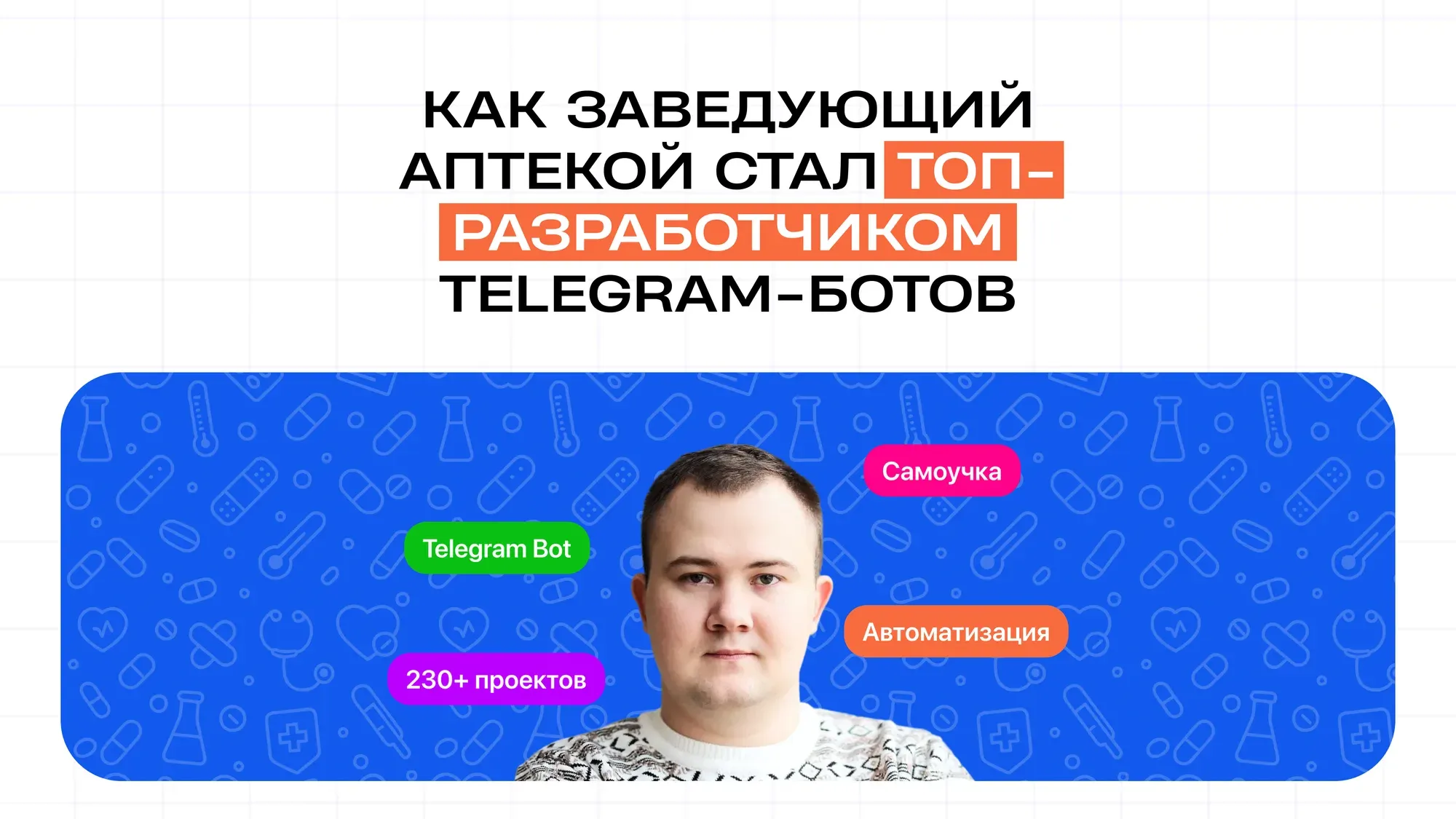
We're continuing our interview series, and our next guest is Yaroslav Ruzhinsky. In 4 years, he went from beginner to an expert who has built more than 230 bots, including bots that have earned tens of millions of rubles, bots with large audiences and very complex functionality, and bots with interesting and unusual mechanics
1. Tell us a bit about yourself. What did you do before bot development?
I'm a very well-rounded person, and I always love trying something new and interesting. I dive headfirst into every hobby and try to get as good at it as possible in a short time. Before I got hooked on building Telegram bots, I worked, and still work, in a management position at a large regional pharmacy chain
2. How did you find out about Telegram bots? What caught your interest? Did you have a technical background?
I found out about Telegram bots in the fall of 2021, when it became clear that most people were moving from Viber and WhatsApp to Telegram. As head of the communications department, I decided to set up a corporate structure for employee communication in Telegram.
Along the way, I realized we needed a bot (at the time, for authorization). I did some surface-level research into the options and the market, and talked to several bot developers about ordering one.
That's how I started exploring bot builders, came across puzzlebot, and got hooked… As for my education, it's not technical at all; I'm a humanities person. I have two degrees: one in pharmacy and a master's in analytical chemistry
3. How did you learn to build bots?
As I mentioned, I don't have and never had a technical education or any IT courses. I'm completely self-taught and learned everything on the job. I'm not afraid to admit when I don't know or can't do something, but I'm always ready to put in the time and figure it out.
I learned to build bots step by step, trying out different setups and mechanics and testing what would come of them. A big role was played by the friendly, cozy community in the chat that is now called "Mutual Aid"
4. Do you remember your first bot? What did you build it for?
Yes, of course. It was the very bot that got me into the Constructor. It's still actively running, although it uses old setups and mechanics that I plan to fully replace with a mini app soon. I didn't build it for a client; essentially, I built it to make my own work easier, but in the end I even got a bonus equal to a month's salary for it, which was a nice perk
5. Did you face any difficulties with development early on? How did you overcome them?
Of course there were difficulties, but I always managed to solve every one of them in one of these ways:
· Test builds and lots of attempts
· Studying the knowledge base
· Discussing it in the "Mutual Aid" chat
6. When did you realize that bot development could become a real profession rather than just a hobby?
I see growth and future prospects in development. We're entering an era of almost complete process automation, and bots are an integral part of it.
I saw that I could make money from it when orders started coming in. And it wasn't the classic path where you start with small orders and then they gradually get bigger, more complex and more expensive: right after my first bot, I got several big, large-scale orders. Literally right after launching my first bot.
I remember it like it was yesterday: it was the end of summer, and I was on vacation. Classic word of mouth did its job. People saw the bot I had made, asked who the developer was, reached out to me and asked me to build a bot for their company
7. Did you make any mistakes working with clients at the start?
Yes, of course, probably the same ones many people make. A vaguely written spec and endless revisions afterward. Working without prepayment and clients delaying payment. Not including the time spent on discussions, writing the spec, calls and presenting the project in my price. Looking back, a lot of time went into that; now I take all of it into account
8. Where do you find clients now?
Word of mouth is still the main source. There are other sources too: I work with several marketers, ad specialists and business integrators for a percentage of the clients they bring me, which is about 30% of the orders I get. I also run paid consultations quite often, and clients come from those as well
9. Which project are you especially proud of, and why?
I can't single out just one, since most projects are interesting in their own way. Over the years, I've built around 230+ bots: some are million-ruble bots that have earned tens of millions of rubles, some have large audiences, some have very complex functionality, and some have interesting and unusual mechanics. It's hard to say what criteria make a project "the best", so I think I'll refrain from answering and picking one
10. Do you focus on specific niches or take on any project?
No, I take on absolutely any project and don't stick to niches. Niches don't really interest me, precisely because what I value in bot development is variety and non-routine work
11. Who is a career in bot development a good fit for? What qualities does it take? Do you need a technical education?
This profession suits people who love creating things and coming up with unconventional solutions and approaches. Remote work lets you travel and work from anywhere in the world with electricity and internet. And because Telegram is so widespread, you can make connections literally all over the world.
The most important quality, I'd say, is analytical thinking: you can work without it, but it's very hard. Stress resistance also matters, because a lot doesn't go according to plan during development and early testing. As for a technical education, I'm living proof that you don't need one
12. What advice would you give to beginners who want to get started?
Just go for it and learn as you go. If you don't have any orders yet, don't sit around waiting for them: "invent" projects for yourself and start building, testing and seeing how different setups work. Build it, test it, delete it, build a new one. That way you'll get hands-on practice, not just theory
13. Do you think bot development is a promising profession?
Yes, I think bot development is a promising profession. Telegram will only keep growing, and I predict it can be a career for at least 15–20 years
14. What's the situation with competition and project availability on the market right now?
Competition is very low, so new developers will definitely have enough orders. As for project availability, things are good. I usually have a queue 2–3 weeks ahead.
Over the past year, I've started expanding and hired several people. Two of them came to me for consultations; I saw interesting ideas and potential in them and offered to work together. The other two are experienced specialists for specific tasks