What does every entrepreneur, bot author, and marketer want? To look into the minds of customers and users and understand what they are thinking about, what they need, and what makes them happy. How do they come to buy?
The Customer Journey Map can and does answer all of these questions.
What is it?
Customer journey map, aka CJM - is a description of the customer journey from the moment they have not yet heard anything about you to the moment they make a purchase and beyond.
Important detail: CJM is exactly about the customer journey.
It happens that one person buys a product and another uses it. Therefore, in map-building terminology, a customer is someone who searches, chooses, and buys. User - who uses the product/service.
It can be one person, or it can be two different people.
Why build user journey maps?
CJM allows companies to understand who their target audience is and why they buy or go to a competitor. What the customer touch points are and why they work/don't work. The voice of the call center technician, the availability of parking spaces, the way a business card is handed out can make all the difference in a customer's choice. Companies often work on flow and don't think about the small but meaningful details. CJM helps to see weaknesses, find ways to solve them, and implement the results.
Journey mapping visualizes how the user actually comes into contact with your product. It's easier to see all the small interactions, emotions, and other metrics that influence the buying decision.
Journey mapping helps you see the strengths and weaknesses of your strategy.
Where the customer moves easily from one stage to the next and experiences positive emotions, you're doing well. These points are worth cherishing and improving. When the customer has a problem, you have a problem as well - these stages are worth working on first.
With journey mapping you visualize the customer experience and can manage it effectively.
The better you understand your audience, the more you can do to get them to the point of purchase and continue their interaction with the company.
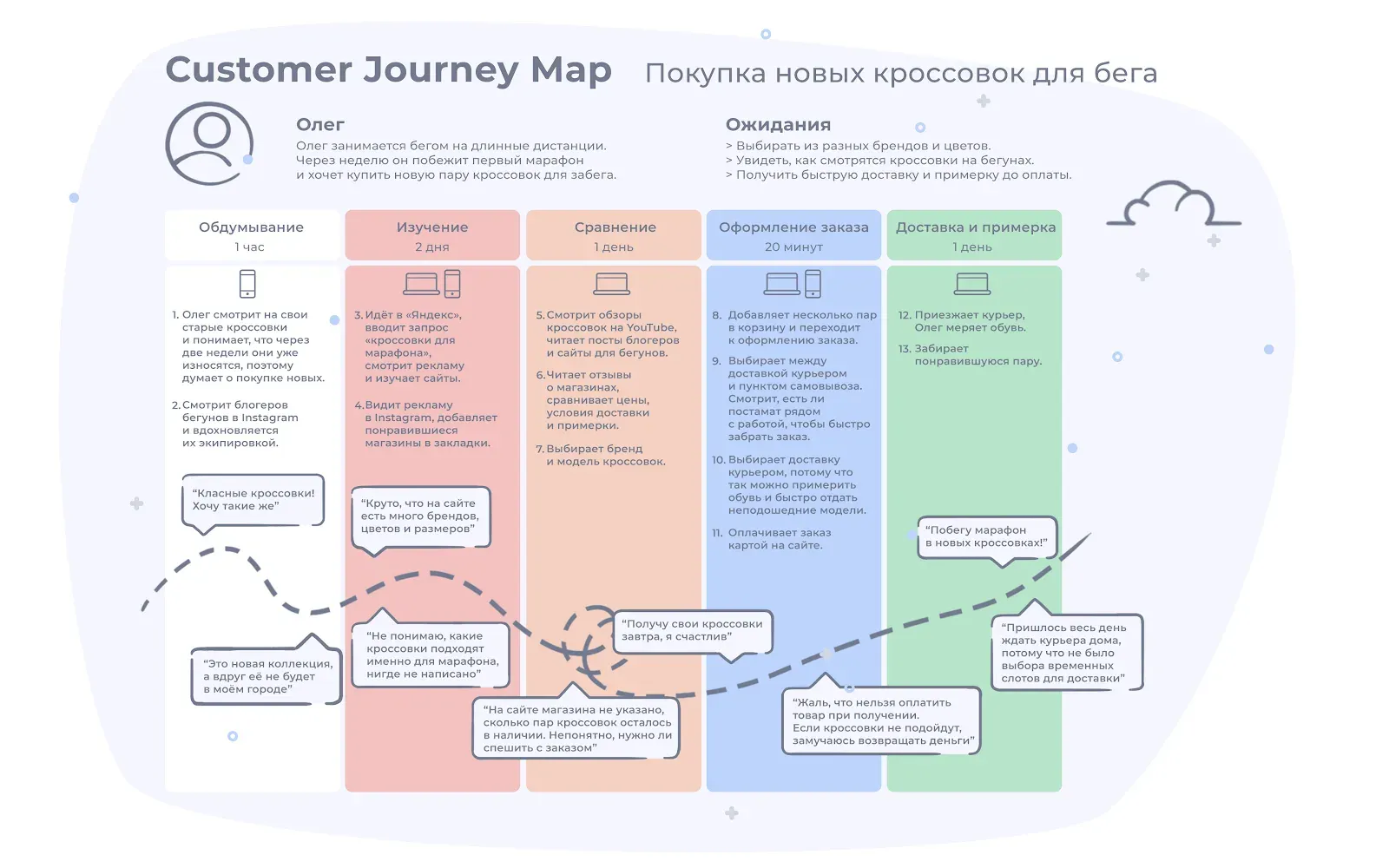
Stages of building a CJM
Customer journeys are not linear.
The customer journey can rarely be represented in linear form from point A to point B because customers often take a cyclical, branching journey. This makes it difficult to accurately visualize CJM.
For this reason, experienced strategists use a variety of methods to present CJM, from notepad notes to Excel spreadsheets to infographics. Most importantly, the map makes sense to those who will use it.
However, before you can dive into creating a CJM, you must first gather data from your clients and potential clients.
Step 1: Gather information.
1. Recall the target audience research you've already collected
Chances are, you've collected data about your customers before. They can be useful, too, just don't forget to clarify a few questions:
When was the data collected?
Is this data still relevant to describe your potential customers?
Does your product help solve these people's problems?
2. Conduct a survey to clarify the relevance of the data
To gather new customer data, you can focus on sample lists of questions.
Open-ended questions:
How do you feel about using the product?
What do you like, what's annoying?
What was your experience buying the product like?
What information would make your buying process easier?
What might make you change your mind about buying the product?
Closed-ended questions:
What is the likelihood that you will buy the product again?
Did you learn about the product from social media?
How often do you use the product
Personal questions: gender, age, place of residence.
Remember that not everyone will find the time or desire to take it. The shorter the survey and the more specific the questions, the more likely it is that a person will finish it.
3. Gather data from the website and social networks
The more you know, the better the customer journey map.
4. Talk to your colleagues who work with customers
Your sales team knows best about user barriers and stop-factors, and tech support knows best about the problems users face. It's all very important to get the most out of your users' story.
A sample list of questions to ask your colleagues:
What are the common problems customers face?
What impressed them about working with your product?
What obstacles have they encountered?
What questions do they ask when they are looking for a solution to their problem?
5. Talk to your customers.
Now reach out to your users in person to learn the most important things firsthand.
Most likely, in a face-to-face conversation, customers will answer questions more thoroughly and share the things that are hurting them. This will be a great addition to the information you've gathered through the survey.
You can build on this list of questions and start with five to ten clients:
How did you know you needed the product?
If you didn't buy the product, what made you look for an alternative?
What problem did you want to solve with the product?
What information about the product was difficult to find?
What would have made the purchasing process easier?
What would have made your experience with the product better?
Step 2. Draw a portrait of the customer —
average image of a user who is interested in and needs the company's product.
The main characters of CJM are the characters that tell the story of your customers.
Buyer-persona is a collective image of some category of your customers, who are united by behavior, way of thinking, goals and values, some other attributes.
You'll need to think of several personas for your customer journey map, because your customers include different people who solve their problems in different ways and come to buy your product in different ways.
When describing the characters, be as specific and clear as possible. Use the data you've collected throughout the previous steps as the basis for the characters.
You can describe a character through:
age
gender
occupation
place of residence
lifestyle
behavioral habits
goals and values
devices in use
influencers
problems the character solves with your
product
Step 3: Describe the customer journey from discovery to repeat purchases
It is important to describe the customer journey based on real customer behavior, it will be much more chaotic and inconsistent than your business processes.
The first step of the customer journey map (discovery)
Sure, a character can have love at first sight, but that's very rare.
Character Motivation. First, establish the reason why your character started looking for your product. It should be a problem he can't solve without you.
The customer's points of contact with the company. Describe the moments when the customer first interacts with the company that will solve their problem. Document from what devices and from what channels the character receives information.
The character's feelings and emotions. The emotional part of the user's story begins with an awareness of the problem to be solved.
Problems and issues. If you can anticipate those issues that alienate them from buying, you can offer them help in time with a triggered chat message or helpful content to help them make a choice or decide on a future action.
The second stage of the customer journey map (purchase decision making)
Now your character knows your product exists and begins to wonder if he needs it. He knows he can find a solution to his problem in a specific location. The character needs to be pushed to learn more about it and decide to make a purchase.
At the decision stage, it's especially important to understand what difficulties and questions the customer may have. Agree, it would be very frustrating if he left to a competitor just before the purchase.
Step three of the customer journey map (purchase)
Determine what made your customer decide to buy and what was the deciding factor in their decision.
At this stage, it is critical that all sharp corners are ironed out because it can significantly impact your buyer's customer experience and their willingness to make repeat purchases.
Stage four of the customer journey map (repeat purchases)
Regular customers bring in the most revenue - it's important to understand why customers do or don't make a repeat purchase.
In this step, capture everything that happens after the purchase is made.
Step 4: Analyze the customer journey map and eliminate weaknesses
Look at what you've captured in your customer journey map. What steps do customers walk away from the most? What do they find challenging? What triggers their negative emotions? What do they have doubts about?
Chances are, this is already on your map - it's time to incorporate tasks to address these gaps, improve the product, service, customer service, and everything else that matters to the customer.
Step 5: Start over.
Building a customer journey map is an ongoing process of reflection on the customer experience of interacting with the company. After you've worked on the weaknesses, the customer journey has changed - go back to step one and start over. Success!
Useful tools for building user path maps
Finally, we left a small list of tools that can come in handy when working on any kind of maps: