We use our experience to tell you how to combine the three segmentation frameworks - ABCDX segmentation, JTBD theory and User Journey - to collect useful insights about your customers: their problems, motivations, limitations and opportunities that will help you sell better and not waste resources.
Simple segmentation by demographic characteristics in B2C or so-called firmographic characteristics in B2B is no longer enough. Even behavioral segmentation is not enough if data on users' actions are not complemented by information on the context in which they find themselves. Altimeter's research confirms that traditional segmentation methods have been replaced by mixed methods that take into account customers' motives and context, their online behavior, and data on previous purchases.
Segmentation by gender, age, and geolocation is not enough. Data that our product is bought by Masha, who is 25 years old, does not help to make it better and sell more successfully. Masha could be in charge of support at an online store or be a marketer at a language school. In the first case she will be interested in chat features - the history of conversations, distribution by channels, notes and saved responses for operators, in the second - the tools of lead generation and qualification: chatbot, automatic invitations to chat, trigger emails.
How many Mashas need a chatbot, and how many dream of their own little chatbot? How much money will each one bring in? How long will it stay? In order to know all this, develop the service and optimize sales channels, you need to conduct qualitative research on the target audience, combine different types of segmentation and frameworks with each other. And the data from qualitative research needs to be backed up by quantitative research and correlated with metrics at each stage of the funnel and within the product.
Why segmentation is necessary
Potential buyers are not a homogeneous group, they differ from each other not only by gender, age and geography in B2C or business segment, company size, website traffic and profit in B2B, but more radically:
The problems they want to solve with the product;
The context they are in;
What drove them to find the solution;
The buying power;
The amount of time you have to spend working with them.
Communicating with everyone the same way is not effective. Every user has different characteristics and problems. Customer segmentation allows you to identify similar characteristics, group users and personalize communication.
You should know that your competitors are already using user segmentation. According to Altimeter research, only 2% of businesses do not use segmentation.
What happens if you don't do segmentation
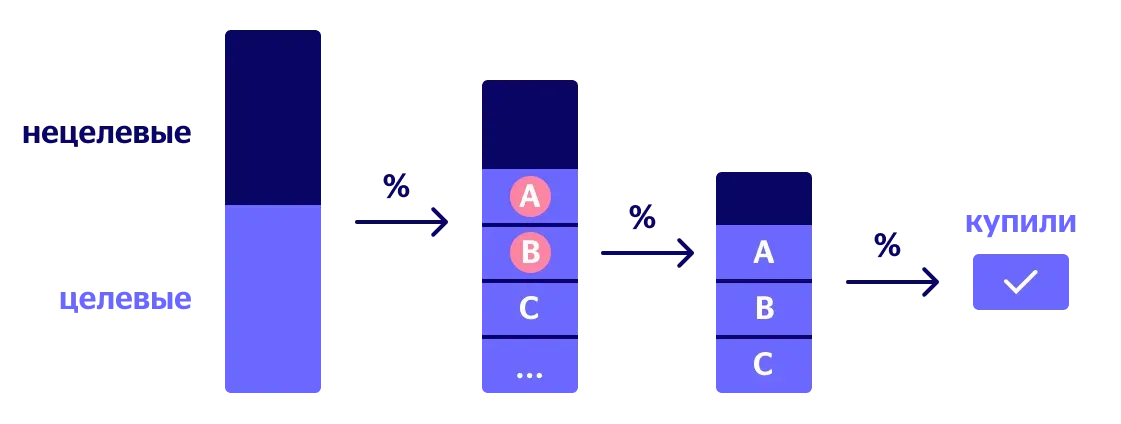
Different users come to the bot, ⅔ of them are untargeted traffic, and the remaining ⅓ are potential customers. Segmenting customers in the sales funnel means prioritizing team time and saving resources. If you don't know who your target audience is, what tools they use, what tasks they solve, and what they want from your product, you could easily waste all your resources on untargeted leads.
Leading all potential customers through one common sales funnel is impractical. You will waste your time and money by offering the wrong products to the wrong people. Conversion of such a funnel will tend to zero, and you will lose potential buyers.
How to segment your customers
The most important part of any research is defining goals and objectives. The results of the segmentation study will be used by different teams - marketing, sales, product. Agree with each stakeholder what they expect, what kind of research results are needed, and how those results will be used in their work.
Here are the three key steps that we have identified:
1.Segmentation.
If you work in B2B, your customers will be companies.
2. Creating portraits of Buyer-persons based on segmentation and additional interviews.
Buyer-persons in this case will be employees of these companies with specific roles and job tasks.
3. Designing a sales funnel for each persona.
We use all three approaches for segmentation:
ABCDX segmentation - suitable for companies with more than a thousand paying users;
JTBD segmentation - also used to find new segments;
Segmentation based on User Journey - one of the universal ways to divide users by the work they do in the service.
Using three frameworks for segmentation helps us thoroughly study users, identify their pains and motives. All three models complement each other perfectly and help us build a complete picture of users with which to grow the business.
ABCDX segmentation
The essence of ABCDX-segmentation: you divide users who have bought from you at least once into four segments - according to the value that these customers got from the product.
A - there is pain, the product is very much needed, so high conversion to purchase and constant use.
B - there is pain, the product is much needed, but there are objections. Pays a lot, but takes quite a long time to make a purchase decision.
C - the pain is partially closed, there is a need for the product, but the value is not high. Willing to pay little and there are a number of significant objections.
D - there are a lot of questions and objections, most often end up not buying.
X - a big client who needs something specific, some personal improvements that you are not ready for.
How to apply ABCDX segmentation:
Categorize your current customers into ABCDX categories.
Find and record the main characteristics of each segment.
Compose qualifying questions that will help you quickly determine which segment each new customer belongs to in the future. These questions can be used in sales at the start of the dialogue or during registration.
Examples of qualifying questions for ABCDX segmentation:
Name
Website
What country does the company operate in?
What is your role?
The field in which your product operates?
How many employees does the company have?
How many people on the support team (for example)?
Number of customers/subscribers?
Other information obtained
Segmentation by JTBD.
Its essence: customers do not buy products, but "hire" them to do certain jobs. Each product has one large core job, which can then be broken down into dozens or even hundreds of smaller jobs.
Within these large jobs there can be hundreds of small jobs, each of which occurs in a specific context. It is best to describe them in Job Story format:

The Job Stories combination allows you to collect user profiles with large jobs.
How to apply JTBD segmentation:
The first step is to identify, through interviews, the similar patterns in customer behavior that led to a purchase, as well as their pains, motives, and context.
JTBD segmentation questions from Dmitry Kapaev, researcher and author of the Work Theory course:
On determining motive:
Why did you decide to buy ____?
What were you thinking when you bought ____?
What did you want to accomplish with ____?
On determining context:
What was the reason for buying ____?
What prompted you to buy ____?
Where were you at that moment?
On identifying pain:
Why did you need ____?
What were the challenges of using ____?
On identifying other solutions:
Why did you choose ____?
What other options did you consider besides ____?
What features were important to you in making your purchasing decision?
Once you've identified the key work that customers do with your product, segment them by that work and supplement it with firm data. In our experience, you should conduct at least ten qualitative interviews with customers to identify key work.
Segmentation based on the User Journey
The User Journey or Customer Journey Map is a description of the customer journey in a product from the first introduction to the company to the first purchase and further use of various features.
Users go through certain stages of their life cycle in the product. Studying the User Journey within a product helps you improve the product in the first place, as well as conduct research on segmentation of users based on what features they use and for what purpose.
User Journey segmentation is based on collecting data on user actions and subsequent customer interviews. Customer Journey analytics allows you to segment users into groups based on what features they use and how actively they use them, as well as what problems and limitations they encounter most often.
How to apply User Journey segmentation:
Collect user data and analyze it.
Build funnels by the stages customers go through in the product. Some of the users will use one feature after registering with the product, some will use another.
Conduct interviews with customers to adjust the data. After collecting the data and preliminary segmentation with funnels, you need to supplement the information obtained with the stories of the customers themselves. Chances are the funnels built don't fully reflect the customer's journey in the product, but with qualitative interviews, you can identify key insights about how the service works.
List of questions for User Journey segmentation:
The purpose of the User Journey interview is to determine how the user works in the service: how they find the right function, how they use it, where they go for help.
Interview questions for User Journey:
What does your company do?
Size of the company?
What kind of work do you do?
What kind of tasks do you solve?
What tools do you use to do this?
For those who have recently registered:
Tell us how you went about registering for the service: what did you do, where did you click?
What did you see?
Where were the difficulties?
For those who have been using the service for a long time:
What features do you use?
How do you solve problems?
Where do you go: to the knowledge base or write to support?
How do you use a particular feature?
Segmentation by User Journey will help divide users based on their paths in the product and the main functions they work with, but for a complete picture of the segments you need to use all three frameworks to qualitatively divide customers into groups.